From Saint to Sinner
Cesar Chavez: how do we honor a movement when its leader caused harm to the people it was meant to protect?

Today’s post was going to be an unabashed celebration of a man’s great achievements in helping his fellow men gain better working conditions, a living wage, and respect for their dignity. However, due to a recent exposé about his abusive actions in private, his public accomplishments must be looked at in a different light. Today in the US is Cesar Chavez Day, and today’s post is about the achievements and the crimes of this man.
Chavez is famous for leading the farmworker labor movement in California in the 1960s and 70s and remained its symbolic leader until his death in 1993. In 1962, he co-founded the National Farmworkers Association with Dolores Huerta and Gilbert Padilla. At the time, farmworkers had minimal labor rights: no minimum wage law, no right to organize, and no collective bargaining. Chavez helped change that. In 1965, farmworkers who worked on grapes in Delano, California went on strike. The Association joined another labor organization and created the United Farm Workers (UFW) union, a union that still operates. The UFW became central in supporting the strikers, raising awareness, leading a national boycott, and negotiating on behalf of workers. The initial demand by the workers was to be paid at least the national minimum wage offered to non-farmworker employees, $1.40 an hour. However, as the strike lasted, the workers also insisted upon union recognition, health and safety checks, and the ending of child labor. It took five years of striking, but ultimately the companies relented to the workers’ demands, catapulting Chavez and the UFW to national prominence.
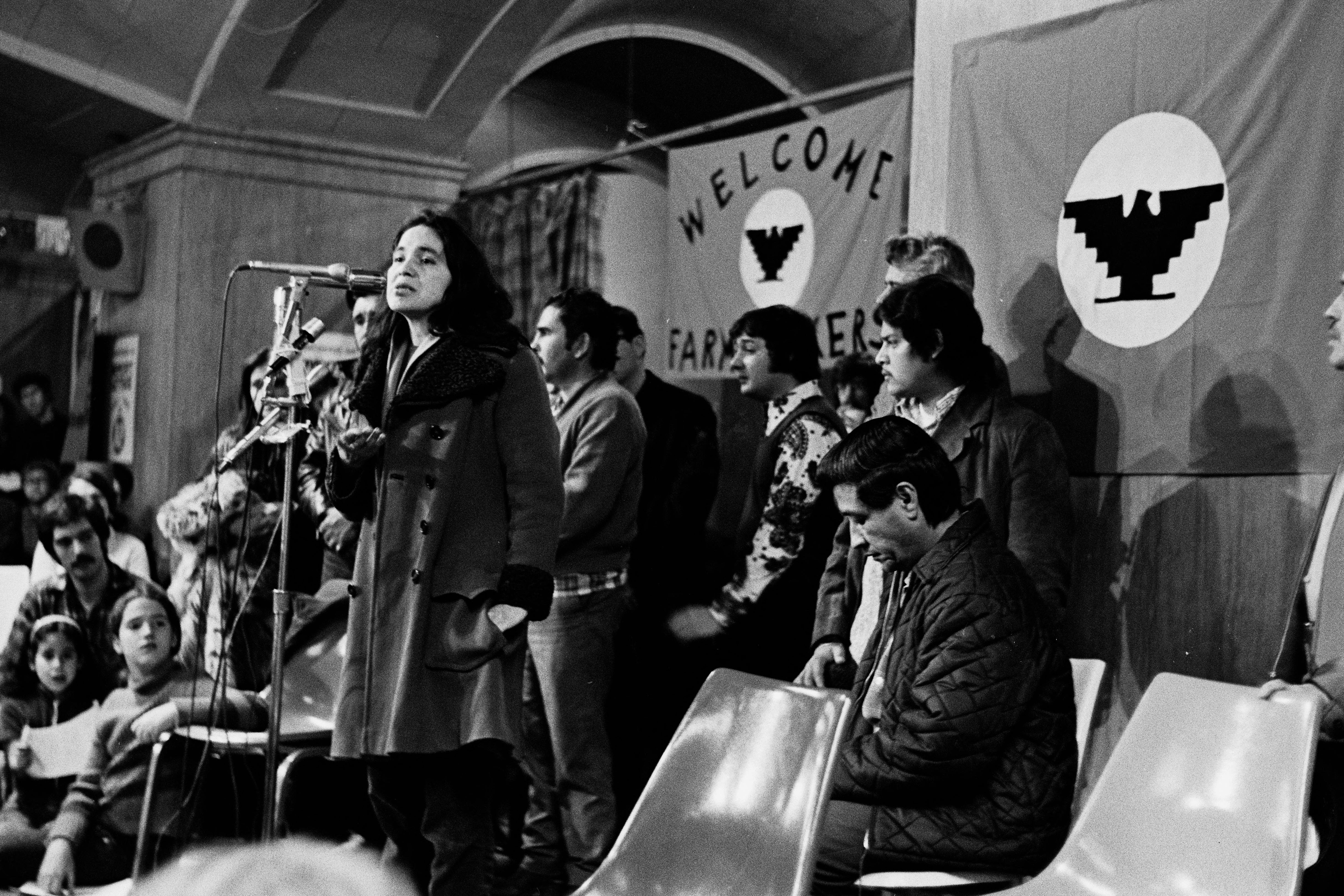
_also_Pictured._Photos_by_Ted_Pearson._Feb_19,_1973_Slide_20.png)
Years of grassroots organizing gave Chavez and the UFW the legitimacy to politically represent the farmworkers. After the successful end of the Delano grape strike, the UFW represented 50,000 farmworkers and successfully lobbied the state of California to pass the 1975 California Agricultural Labor Relations Act. This law granted farmworkers the right to unionize, and it remains the most robust farmworker labor law in the United States.
During these campaigns, Chavez became the face of the movement through his charisma and willingness to make highly visible personal sacrifices. Three times, he fasted as a way to impose political pressure. He led a 340-mile / 550-kilometer march from the farms up to the state capitol. He presented himself as a Ghandian figure, willing to sacrifice himself for the cause.
But the larger-than-life persona and the reverence he commanded also placed him beyond the reach of accountability within the movement; he could do anything he wanted without consequence. And what he did was to take advantage of the most powerless in the movement. The exposé describes how Chavez deliberately cultivated the trust of young girls – one as young as 12 – before isolating, molesting, and raping them. His abuse lasted years. While there were whispers of this abuse in the 1980s, nothing became public until this month.
This raises the question of how we should treat public figures that have both achieved great accomplishments and committed immoral acts. It’s morally wrong to ignore their abuses, and it’s historically wrong to pretend they weren’t an important figure. This isn’t the first time this question has been raised. In the United States, there has been an ongoing discussion on how to understand the fact that the founding fathers preached liberty while practicing slavery. Contemporaneous with Chavez, Nelson Mandela helped end South African apartheid while also unapologetically praising Libya’s Gaddafi, even after the Abu Salim prison massacre. Each person needs to be judged in their context. However, considering that it’s unclear to what degree Mandela knew about the massacre, Chavez’s actions certainly seem the more morally reprehensible of the two.
For this final Cesar Chavez Day, we should take a second look at the activists heroes that we have turned into mythic figures. No matter how great their accomplishments, they remain flawed humans. Their great acts don’t negate their mistakes, nor should charismatic public personas be allowed to cover up private wrongs. While it’s easier for us to think of them as one-dimensional do-gooders, making them morally unassailable is what gives them the opportunity to abuse their power and harm those around them.