War Without Limits Means Suffering Without End
Henry Dunant: the man who invented humanitarian law

On 8 May 1828, a man called Henry Dunant was born in Geneva and grew up focused on making money as a businessman. During a voyage in 1859, he passed the small town of Solferino in North Italy, and what he saw shocked him deeply. The Battle of Solferino had just ended, and back then, wars looked quite different from the wars we unfortunately still see in many places today. The opposing armies would march into the battlefield and fight each other until they decided to stop. Then, the soldiers would go back to their camps, if they still could. What Dunant saw that day was a field covered in wounded and dead bodies. The armies were gone, but they had left behind everyone who wasn’t able to make the way back on their own. Dunant, who was staying in a nearby town that night, was said to have gone back and forth with his carriage to bring wounded soldiers from both sides to the care of the local women.
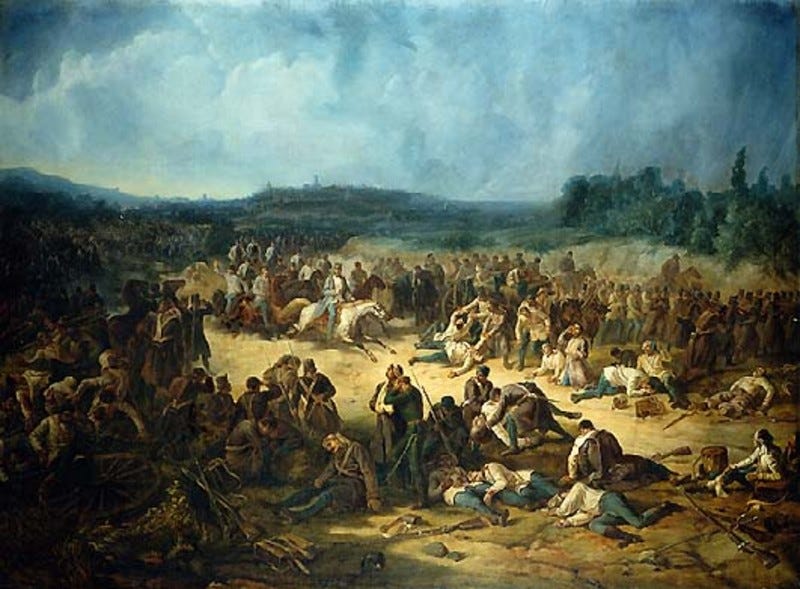
.jpg)
The scenes from this day had moved Dunant so much that he published in 1862 the book A Memory of Solferino. A year later, together with four others, he founded the International Committee for the Relief of the Wounded – now much better known as the International Committee of the Red Cross. Their focus was to provide relief to wounded soldiers and to establish key humanitarian principles. Nowadays, the Red Cross (or Red Crescent) also provides humanitarian relief for civilians affected by armed conflict, but back then, wars were usually fought in open fields outside populated areas.
Shortly after the establishment of the organization, the first Geneva Convention was adopted in 1864, an international agreement dedicated to the “Amelioration of the Condition of the Wounded in Armies in the Field.“ This agreement became the basis of the developing body of the law of armed conflict. Nowadays, we usually refer to this area of law as International Humanitarian Law because the rise of human rights and the growing focus on humanitarian aid shifted the perception of the applicable law during war. While the old understanding of the laws of armed conflict were military-based and focused on allowed and prohibited conduct, the post-WWII framing of humanitarian law emphasizes the aim to protect victims of armed conflicts and focuses on the human rights dimension.
After having put most of his time and effort into this noble project, Dunant faced personal hardship. He had neglected his business for years, went bankrupt in 1867, and subsequently left Geneva in poverty. It wasn’t until the 1890s that a journalist rediscovered the man who had dedicated his life to protecting those who suffered the consequences of wars. This rediscovery of his humanitarian efforts led to multiple honors being heaped upon him, including him being a co-recipient of the world’s first Nobel Peace Prize in 1901.