“We hold these truths…”
The US Declaration of Independence turns 250!

Whether you live in the United States or have just heard of it, you probably know the big celebration that is the Fourth of July. It’s America’s birthday, but the anniversary is more than just a political event. The declaration underlying this date is chock full of concepts of justice and rights.
On 4 July 1776, the Continental Congress approved a document whose stated purpose was primarily political: explain why thirteen British colonies were severing ties with their king. But the justification Thomas Jefferson built for that separation wasn’t grounded in tax grievances or colonial administration. It was grounded in rights.
“We hold these truths to be self-evident, that all men are created equal, that they are endowed by their Creator with certain unalienable Rights, that among these are Life, Liberty and the pursuit of Happiness.” The US Declaration of Independence uses the language of natural rights. Natural rights is the revolutionary idea, stemming from the Enlightenment, that fundamental rights don’t come from kings or governments. They exist prior to government, embedded in human nature itself. A government’s legitimate purpose is to secure them; when it fails to do so, the people have the right to abolish it. That argument is what the Declaration actually is.
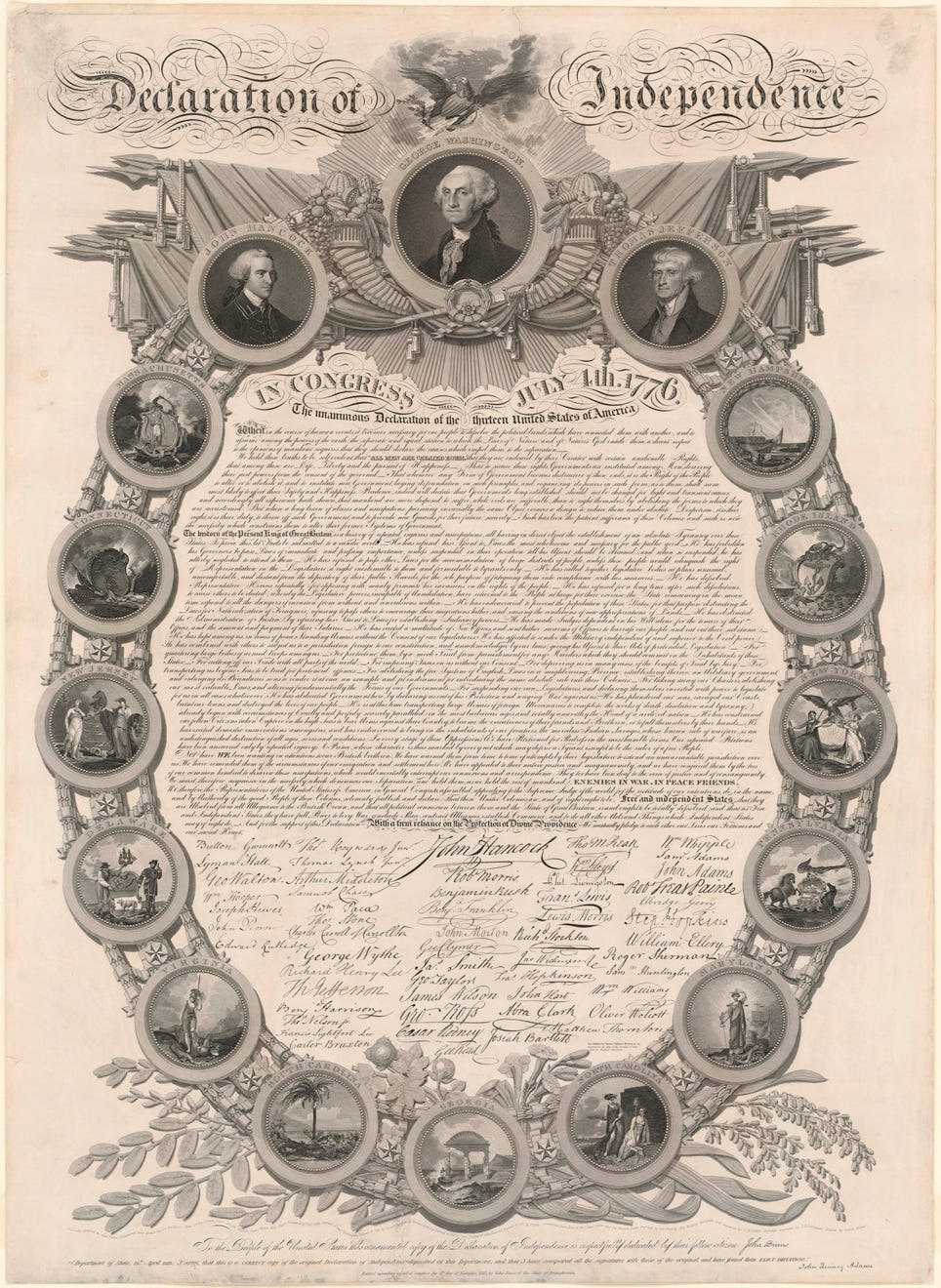
However grandiose and celebrated this document is, there is an unavoidable issue: this great declaration of universal rights was written by a man who held slaves. Thomas Jefferson enslaved more than 600 people over his lifetime, freeing only a handful. The Declaration proclaims that all men are created equal but was produced by a body of men who understood perfectly well that the phrase did not, in practice, apply to the people they held in bondage. The moral force of the words and the moral failure of the men who wrote them exist side by side, permanently.
It fell to others to take the words at face value. In 1791, the enslaved Toussaint Louverture invoked the same Enlightenment language of universal liberty that Jefferson had used – but insisted, correctly, that if rights were natural and universal, then they weren’t dependent on race. He helped spark the revolution that culminated in Haiti’s independence in 1804, making Haiti the first nation born from a successful slave revolt and the second independent republic in the Americas.
The Declaration’s reach didn’t stop there. The 1948 Universal Declaration of Human Rights drew on the world’s existing rights traditions, including the US Declaration – most notably in the UDHR’s own foundational statement in Article 1, “All human beings are born free and equal in dignity and rights”.
The US Declaration had, in effect, supplied a genre and a rhetorical framework that Haiti used, applying “all men are created equal” to people the American document’s authors had excluded from its promise. This language was then taken further to a truly universal level in 1948. This is the power of the idea of fundamental rights: each generation has the opportunity (or responsibility) to re-assess what these ideas mean and how they should apply to the modern world.